
When you put something sharp into a llama or an alpaca, it is a no-brainer: he is going to want to move. That is simply a Law of CAMELIDynamics! If you think that the animal must be still in order to receive an injection, then you have no choice: you must restrain him.
The problem is that when you restrain frightened animals, they fight — and you often get more movement, not less. Fighting gets everybody all worked up before you even get started. Imagine how you would feel if you were physically restrained to get a shot. I know that I absolutely couldn’t stand it.
With most medical procedures, the animal never has a chance to actually experience the procedure and react to it. The restraint is applied first, before the procedure is even attempted. In fact, the wilder and more difficult your alpaca or llama is in the chute, the more likely he or she may be better without it.
When you restrain frightened animals, they fight — and you often get more movement, not less.
Why restraint doesn’t necessarily stop movement
The needle for a subcutaneous injection is placed under the skin a half an inch, maybe less; an intramuscular injection an inch, maybe a bit more. I don’t care how strong you are or how good your chute is: you cannot restrain a llama, or even an alpaca, in a manner that makes him incapable of moving an inch.
Given a camelid’s long neck, it is very difficult to eliminate bodily movement by tying the head — even when the animal is inside a chute. No matter how you truss the llama or alpaca up when giving an injection, you must still be prepared to move with the animal, or he is going to move away from, and off, the needle.
Since you have to learn to move with the animal anyway, simply contain the camelid instead of restraining him — and let him move.
The advantages of giving injections without restraint
The CAMELIDynamic no-restraint method offers many advantages:
- There is less movement.
- Any movement is less violent, less erratic, and can be more predictable.
- The camelid stays calm.
- The muscles are not tight.
- There is less likelihood of abscess.
- It is faster and easier.
- You can work alone, which saves time and labor and also feels safer for the animal.
See a no-restraint injection in practice
In this demonstration, Marty McGee Bennett works with alpacas at Sweet Blossom Alpaca Farm to show how good positioning, preparation and handling can make an injection possible without physical restraint.
Before you start: get organized
Being organized makes you feel competent, and it also makes you appear competent to the beings that are on the other end of the needle. You will be able to work more quickly when you are organized. That is important for you and doubly important to the critters waiting their turn.
Imagine going to get your flu shot. The nurse sits you down, but you have to wait for fifteen minutes. Then he can’t find the needle and finally, after fumbling around for a few minutes, asks you: “Weren’t you just in here a minute ago? Didn’t I just give you a shot?” Not very reassuring!

Set up a catch pen for herd health
Even if you have a chute, the easiest way to give injections is still in a catch pen.
Place as many animals as will comfortably fit in the pen. They should be on the crowded side, but they won’t be there for long. If you have only two or three animals, make the pen smaller with bales of hay or use a smaller pen.
Crowding camelids for injections works for two reasons:
- They slow each other down, making it easier to give an injection as they move.
- Llamas and alpacas feel safer in a group and tend to act out much less.
Hang a bag of hay inside the pen or in each corner. More animals = more hay bags. If they fight over the hay, remove it.

Packing pen percentage (PPP)
The packing pen percentage is the amount of free space you should have in a pen when performing herd health.
Aim for 25-30% free space in the pen, with the rest occupied by your alpacas or llamas.
The number of animals in the pen is irrelevant. It is all about how much room they have to move: too little available space, they fight and rear; too much space, they dash around, move too fast, and change direction.
Have your injection equipment ready
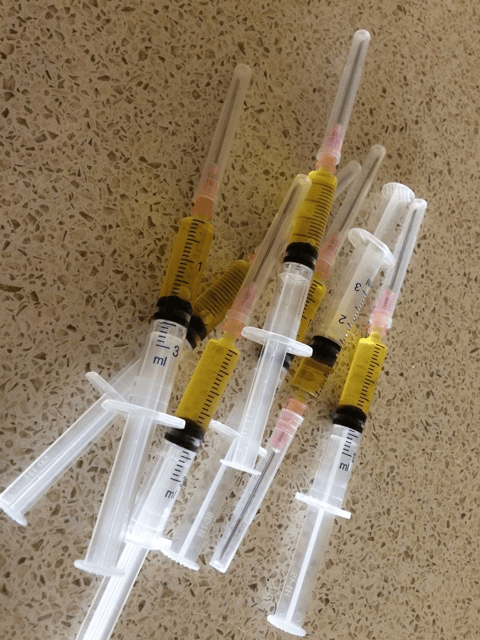
Before your animals are even in the pen, draw up all your injections.
Put your syringes and record-keeping clipboard somewhere you can reach them while standing inside the pen. A small table just outside the pen is perfect.
Wear an apron with a pocket in it for your syringe or syringes. A carpenter’s apron is perfect. And remember: always keep the cap over the needle until it is time to use it.
Keep records as you go
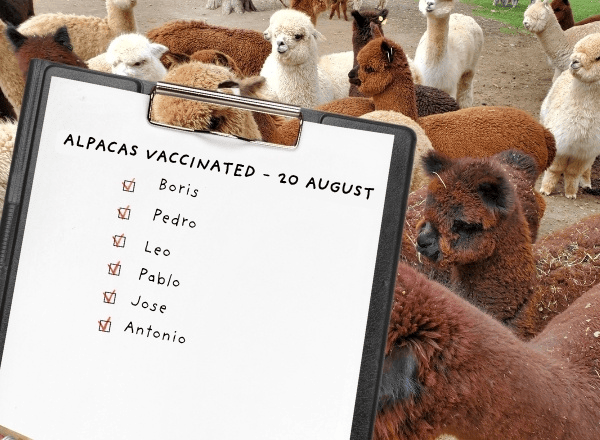
Write down the name or number of the animal and what you gave immediately after giving the injection.
I also think it is a good idea to write a brief comment on how the animal behaved. In this way, you can track your progress and the animal’s progress.
Keep all the animals in the pen even after you have given them the injection — unless you have a rabble-rouser. Give any troublemakers their injections first and shoo them out.

Giving more than one injection
If you are giving multiple injections to the same animal, I recommend giving both injections one after another to the same llama or alpaca rather than giving a round of medication #1 to everyone followed by a round of medication #2.
The animals have a sense of being done and relax more completely using the first strategy.

Working with a larger herd
If you have a larger herd, you can herd the whole group into a holding pen and move groups of eight to ten into the catch pen, letting them out to the field when the group is finished.
Using this system, no animal is ever alone, but you don’t have to keep the entire herd confined the whole time.
Needle size and gauge
Use short needles, around 3/4 or one inch. Many vets use an inch-and-a-half needle, I think, because it’s versatile. If you need the extra length, you have it; if you don’t, you don’t put the needle in so far. Easy if you have given thousands of shots, but a bit daunting if you are a rookie.
Using long needles causes newbies to put the needle in tentatively, which usually means slowly. Yikes!
A needle gauge is a number that tells you the thickness or outer diameter. My preference is to use an 18-gauge needle for everything. You almost have to use an 18-gauge needle to inject viscous medicines anyway, so I just buy those and use them for everything.
I don’t think the animal is really and truly aware of the difference between an 18-gauge and a 20-gauge needle going through the skin. It is more a matter of our perception than theirs.
Our alpacas and llamas are much more concerned with our proximity than with the actual needle. If I can get injections done without restraint and more quickly with an 18-gauge needle, I am going to choose that strategy.
How to give an injection without restraining the alpaca or llama
The trick to giving injections without restraining the animal is to become adept at influencing which way the animal moves. That allows you to move with the animal as you continue giving the injection.
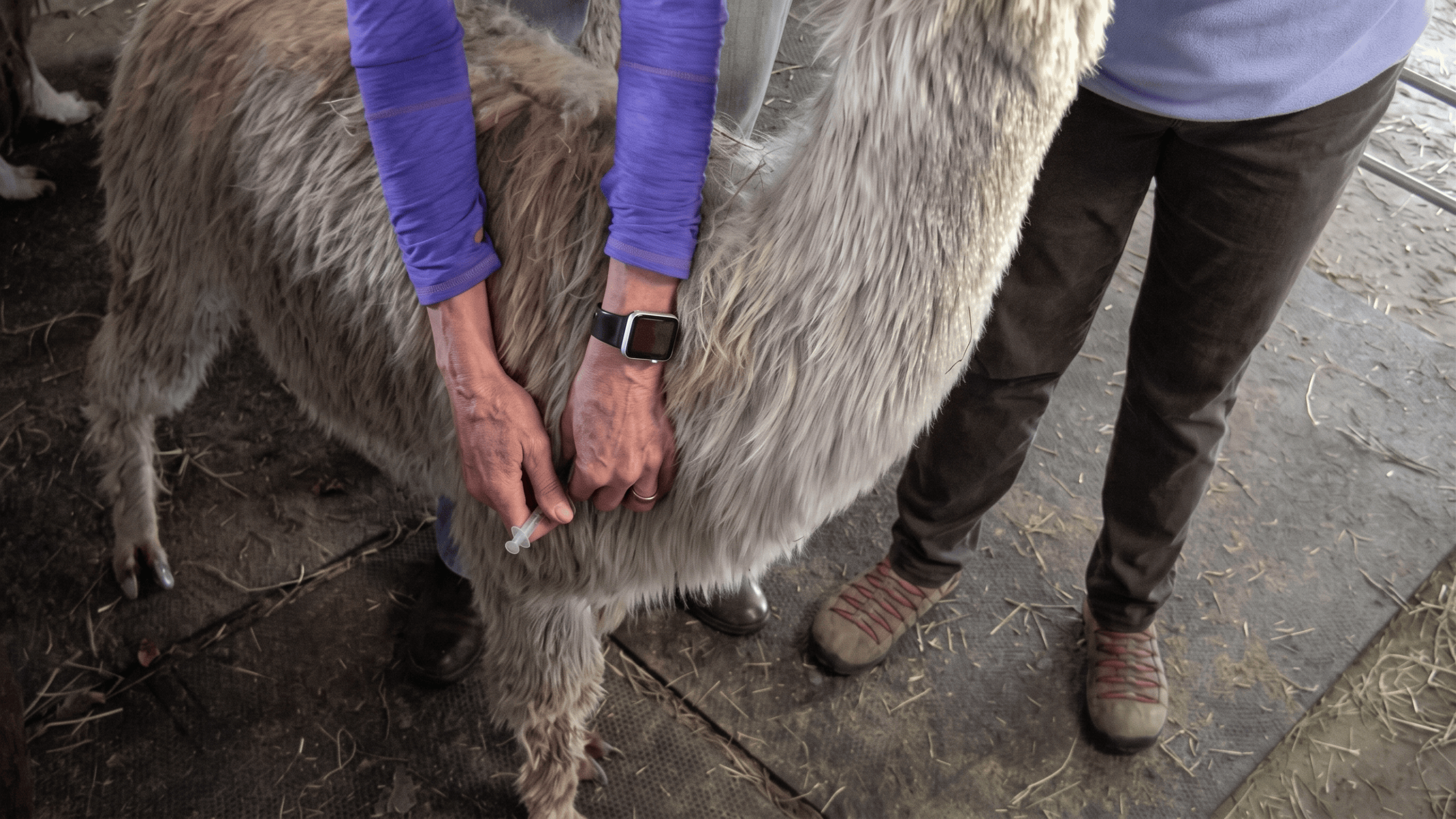
- Stand at the center of the pen and approach your alpaca or llama from behind the eye.
- Walk directly up to the animal, reach across the body to the opposite side and get yourself a handful of wool. I grasp the wool between my fingers and thumb. Remember: move with the animal. You are not using the wool to try to slow down or stop movement.
- Use the wool to pull the skin away from the body. Using more wool makes this much more comfortable. The wool pulls the skin away from the body, creating a skin tent.
- Insert the needle just behind the pad of your thumb and aim the needle at the body of the animal so that you inject the medication into the skin tent.
- If your animal attempts to turn to the outside and change direction, use your hip to bump the rear end of the animal to the outside. This action pivots the camelid around his center of mass and keeps him moving in the same direction.
- With your animal moving around the outside edge of the pen and you in the center, it is easy to keep up with the animal’s movement as you inject the medicine.
Choosing injection sites for alpacas and llamas
Before giving an injection, you need to know where to inject. You have some options. There are injection sites located all over the body. Some work for no-restraint injections and others won’t.
Stick something sharp in a camelid’s rear end, and you can be sure he will do one of two things: move forward and maybe kick. Unless you stop the animal from moving forward, it is very difficult to keep him from walking right off the needle. Stop the llama or alpaca in the front, stick something sharp in his butt, and he rears up or bucks — also not good.
Although the hind leg muscle mass is greater, I still prefer the front half of the body for injections unless that is not possible. Most veterinarians these days agree that injections in the front half of the animal are preferred to those in the butt.
Some veterinarians like to use the armpit. I don’t like this site because it is difficult to use without restraint. Sometimes there is no perfect choice.
Provided the site is safe, I will opt for the one that is easiest for the animal.
Subcutaneous injections in alpacas and llamas
If you are part of a team, it may be easier, especially in the beginning, to work with a partner.
The most important thing to remember is that your helper’s job is to STEER — not to hold, restrain or even try to slow the animal down.
I prefer that my helper use a technique I call the bracelet to steer the animal. The bracelet is not about holding. In fact, you make very light contact with the animal. One hand is placed lightly just behind the ears and the other in the groove just behind the bottom lip.
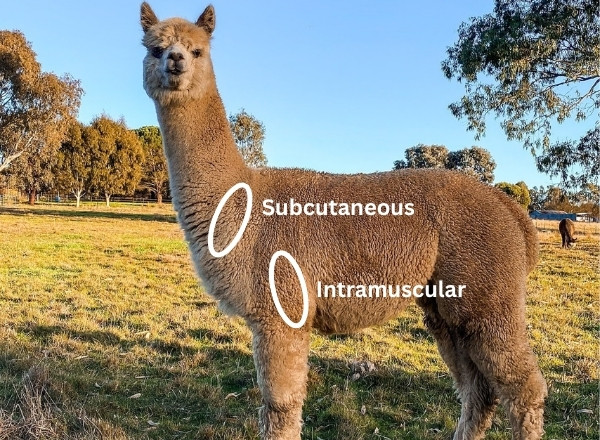
A subcutaneous injection — often called a sub-Q injection — is given under the skin. This is the easiest medical procedure there is. Most medications, even antibiotics, can be given this way.
Give sub-Q injections as low on the body as possible on the front half of the body. As much as possible, keep injections below a line drawn between the point of the shoulder and the point of the hip. I like the area where the neck and shoulder meet. The skin is relatively loose in this area, and there are no bones or major vessels to worry about. This site makes it very easy to follow the llama or alpaca as he moves.
The crease of the neck is also an easy place to check later for a reaction (and to treat in the unlikely event there is one).
Intramuscular injections in alpacas and llamas
The site for an intramuscular, or IM, injection is a bit different, although it is still in the front half of the body. I prefer the back of the forearm — the triceps muscle. Dr David E Anderson, DVM, MS, prefers sites in the front for two reasons:
- They are easier to use without restraint.
- He believes that the medicine or tranquilizer acts more quickly when given in the front half of the body.
He feels that this muscle mass will accommodate up to 5 cc of medication for alpacas and slightly more for llamas.
Giving injections with two people

If you are part of a team, it may be easier, especially in the beginning, to work with a partner.
The most important thing to remember is that your helper’s job is to STEER — not to hold, restrain or even try to slow the animal down.
I prefer that my helper use a technique I call the bracelet to steer the animal. The bracelet is not about holding. In fact, you make very light contact with the animal. One hand is placed lightly just behind the ears and the other in the groove just behind the bottom lip.
What if an alpaca or llama is very sick?
You should, of course, consult with your veterinarian about health care.
When animals are very sick, and you must give large doses of medicine repeatedly, you may need to use injection sites all over the body, including the rear half.
A sick llama or alpaca is not likely to protest very much, no matter what site you choose. When the animal begins to feel well enough to fight, I would switch to the front half and rotate from one side to the other.
Less restraint, more skill
Giving injections without restraint does not mean ignoring movement. It means learning to work with movement rather than fighting against it.
Contain the animal appropriately. Be organized. Understand how camelids move. Know where you are going to give the injection. And be prepared to move with the animal. The result can be a calmer, quicker procedure for both you and your camelids.
Veterinary note
Always consult your veterinarian about your camelids’ health care, including appropriate medications, dosages, needle sizes and injection sites. This article was reviewed for technical accuracy by Dr LaRue Johnson of Colorado State University and Dr David Anderson.